A Cartography of Immanence

“Slumber, watcher, till the spheres
H. P. Lovecraft, Polaris.
Six and twenty thousand years
Have revolv’d, and I return
To the spot where now I burn.
Other stars anon shall rise
To the axis of the skies;
Stars that soothe and stars that bless
With a sweet forgetfulness:
Only when my round is o’er
Shall the past disturb thy door.”
It is in the confrontation with a question that the need for philosophy arises. We all carry a monstrous obsession somewhere within us—even though I am aware that such a formulation is merely rhetorical. I have never been a philosopher in the strict sense; I have only, as far as I can tell, become one out of sheer necessity. For it is my own obsessions that have called out for a language. I have therefore found it easier to see myself as a poet or an artist, more than anything else. The draftsman’s obsession with lines; the painter’s obsession with colour; the poet’s obsession with mute truth; the actor’s obsession with the person. All of them carry violent experiences of the confrontation with being. My own obsession is that of maps, of understanding my own positioning in the embroidery of being. Navigating among desires; among ideas, among things and other creatures’ desires, so as somewhere to be able to designate my own habitat. An obsession born of a world’s lack of terra incognita.
It is no surprise that the most painful confrontation for me has issued in the question of who I am. We live, after all, in the decaying body of liberalism and its undead obsession with the individual. But that is also why the question as such is wrongly posed. What the contemporary subject has to face is rather, as Lyotard observed in The Postmodern Condition (1984), a question of position: “where am I?” We find ourselves in a world lacking a totalising narrative and thus also lacking any navigation of where we are and where we are going. Modernity offered the Hegelian project; a telos toward absolute freedom. Art could conjure the path for the new, images that had never before been seen. Music broke through in the same spirit, jazz as music’s own freedom fighter against its own limitations. And literature laid bare the character of the modern subject before its own anxiety born of its agency or alienation.
Baudrillard, for his part, shows how territory in our time has been replaced by the map; reality has been replaced by the hyperreal. He understood that if the map were to become more detailed than the reality it represents, the distinction between them would cease. A map without terra incognita is in itself a map with nothing but terra incognita.
Our time’s confrontation with reality is thus deictic; we find ourselves in a grammatical catastrophe where our language cannot answer to our positioning in time, space, or person in a way that allows us to navigate. Modernity’s catastrophe is also deictic, but that age does not demand an answer concerning longitude or latitude; it demands an answer about an origo. Nietzsche diagnosed modernity’s problem: “God is dead. God remains dead. And we have killed him. How shall we comfort ourselves, the murderers of all murderers?” (The Gay Science, 1974)—God, as answer to the question of existence, is for Nietzsche obsolete. And it is with this in mind that Jordan Peterson weeps about his cultural Marxist enemies: “They want vengeance against God for the crime of Being.” For he envies us this direction; this liberation born of ressentiment against God himself. He cries out like Christ on the cross: why has he forsaken us without an answer to the violent question of Being?—An assurance of the Christian right’s narcissistic hubris toward their own god.
It is also from this point of departure that Heidegger finds himself. It is in the encounter with God—the origo of all being—and his disappearance that he can return to a confrontation with being as such. Dasein as a concept is thus an answer to and an acknowledgment of the rootlessness that arises in a world that has lost the origo of being. Heidegger’s deictic obsession, the reason a concept like Dasein [being-there] emerges, comes out of a crisis in which Plato has been inverted. Yet at the same time it is almost a mockery of us in delirium; the very question we are asking is that of where “there” is, and as such, it is almost laughable how such a concept could be useful today other than as a nostalgic relic from the past.
Genealogy of Origo
How the fuck did we end up here? In such unbearable top shelf vertigo? In delirium? Were we in such need of God that his death left us in indexical amnesia? We seem to have a language capable of producing a diagnosis for this problem, but as yet we lack a grammar that can answer a world that has replaced the territory with a map.
“The Greeks might seem to have confirmed the death of the sage and to have replaced him with philosophers—the friends of wisdom, those who seek wisdom but do not formally possess it.” (Deleuze, Gilles & Guattari, Félix. What is Philosophy? 1994).
In the same way that God became obsolete for modernity, the sages were obsolete for the Greeks; a need arose to take wisdom away from the wise person, and thereby to replace that person with someone who was not wise but who was a friend of wisdom, and thus also someone who could lay claim on wisdom’s behalf. This need came from a problem of saturation: what happens when there are too many wise aunts and old men? When those we can trust to bear truth have become oversaturated, and those who claim to possess wisdom all make contradictory claims? In such a situation we need a new language; a language that separates quality from person. Deleuze shows how Plato is the inventor of this new language; the one who separates wisdom from the human being and replaces the wise man with the friend of wisdom (Difference and Repetition, 1994). Plato’s philosophy is thus an answer to the question of who bears the true claim. Plato’s Ideas, and thereby the Idea as a concept, became a language for carrying out such a sorting among rival claimants. A way of sorting and identifying snake oil.
From Plato’s new language follows a scala naturae. It is a question of the degree to which our claim can correspond to the quality of our object or in our participation. It leaves all participants in existence in a subordinate position to the qualities we possess, or which possess us. I, who participate in this play of existence, can act in line with being wise, and in that way I can also lay claim to being wise. My claim to master wisdom is either groundless or not, and thus my claim is a question of the degree to which my participation oscillates in harmony with wisdom.
Plato’s dialectic is thus, as Deleuze shows, a calculus that measures the difference between rival claimants, and thereby a calculus that can order reality on a scale, from the true on one side to the false on the other.
Out of this new language, Plotinus and scholasticism could provide the answers that feudalism’s material conditions cried out for: a scale of being itself. Everything had its place, and thus God became the measure of all things. God became this world’s origo; a point from which all being could be derived and placed; an absolute guarantor of the position of all things. It was only a question of distance, and thereby the lost could receive the Church’s help in measuring their position in relation to God and navigating themselves to the right place.
But Catholicism would later come to harbour a problem; since the Church had come to replace the Greek philosophers (the friends of wisdom), the dialectic as such also became guaranteed through the Church as operator. Solus Christus—God alone bears the power to sort the true claims from the false. And when the sacramental mediation breaks down, the responsibility falls on each individual agent to create their own calculus. As Weber showed, Protestantism’s advance would lead to God—and thereby also truth as such—being released from the institution. In other words: where the Greeks faced an inflation of claimants—and thus created dialectics as an answer to that inflation and saturation—the Enlightenment faced a deflation of claimants. Science, and later capitalism’s advance, created an ever higher demand for claimants and could thereby dispense with the institution that acted as guarantor of being’s positioning. A terra incognita was opened up, paving the way for expansion both economically and in terms of knowledge.
But in a world that desires the schizoid, the organless, the need for objectivity also increases, for the ecclesiastical yardstick had vanished. Descartes gave language to this open wound and could thereby present res extensa and res cogitans as separate substances. God, not yet dead, becomes positioned within the subject and matter is banished to the object. Descartes could thus secure Plato’s differential calculus between truth and falsehood and re-centre the origo via the subject’s relation to God. But this is on one condition: that God agrees to justify the subject’s position before its object.
At the same time, the empiricists pushed the Platonic question to its extreme. They no longer stood in a position where it was the very claim to the claimant’s qualities that needed to be separated from one another; it was rather the quality’s relation to the object that needed to be separated. Locke managed to produce a language-apparatus that succeeded in this; Plato’s forms could be decentralised into the subject’s own categorical apparatus. This made it possible to observe the objects (Plato’s simulacra) and at the same time point toward the general. It was Hume who would expose a deep-seated wound in this language, threatening stability and the possibility of an origo through the problem of induction. It was furthermore Kant who would complete the project. But where Descartes’s answer required God as guarantor, Kant dispensed with not only God but the whole of metaphysics as such through his transcendental idealism.
In this new situation, it was the human being’s transcendental categories that became the guarantor of our own position. Through a priori conditions for experience as such, Kant could also show that questions concerning being as such (that is, the thing-in-itself) were questions that could be proven to lie beyond possible knowledge. This was the realisation of modernity, and thus—for anyone interested in Cluedo—it was Immanuel Kant who murdered God in the room of noumena, with synthetic a priori as the murder weapon. Joking aside: with Kant’s transcendental idealism, the deictic problem had been both formulated and answered in one and the same move. Kant showed, namely, that the object as perceived by us presupposes a deictic positioning. He thereby shows that deixis precedes all objects and their qualities, and thus also experience as such. But at the same time he places this intuition in the subject’s transcendental structure. The human being as a rational animal is now repositioned as the absolute origo, entirely without God as guarantor, which opens up a new decisive question: “who am I?” When the human being is no longer a quality, but the very condition for experience as such (and further, perhaps even for existence as such); have we not made ourselves into a kind of God? Prometheus cries out: “Consummatum est!”
We are now back. Ironically, it was Kant who made possible the total inversion of Plato himself; it was Kant who placed the origo as full guarantor in the subject and thereby made it possible for Nietzsche to show how the philosopher—the friend of wisdom—wore the emperor’s new clothes. If the subject alone stands as guarantor before being, do we not bear our own responsibility for the question of good and evil? Do we not carry ourselves alone through time and space—are we not the sole judges of our own lives? Nietzsche now finds himself in an unsaturated age; an age that made it possible to dispense with the original problem to which Plato responded. Is that not why Nietzsche writes with an unsaturated hunger? As one who can return to the sophists and restore every charlatan to their place among things? For Plato’s method of distinguishing the thing’s qualities and thereby creating transcendental categories was a way of subordinating the subject to the transcendental qualities. This, in turn, was to ensure that the saturated reality could distinguish rivals from each other and thus place the qualities (and their possessors) in their correct place in a jungle of beings. But in a world that instead wails in hunger, that lacks rivals because its conceptual apparatus has cut the body to pieces in a superabundance of categories, where the categories are borne by a transcendental subject; there it is the things, and thus the simulacra, that demand to have their voice heard.
Deleuze revived metaphysics from the positivists’ and phenomenologists’ declaration of the death of God. Where modernism’s spectre wandered along the devastation wrought by Kant, Deleuze succeeded in identifying the real consequence of Kant’s transcendental idealism—but via Nietzsche. He saw that, through the inversion of Plato, there was also a possibility of inverting Kant. Deleuze could thereby do what Kant had previously done with Descartes: where Kant dispensed with God as guarantor, Deleuze dispensed with the subject as guarantor. In his transcendental empiricism, he could place the guarantor in the objects (simulacra; or rather, the immanent forces of becoming) and thereby do away with the origo altogether. Deleuze thus succeeded in separating the subject from experience as such and thereby gave experience the ultimate guarantor. He had thereby done away with the need for the transcendental and granted immanent difference its consummation. Substance had become obsolete; hence all that remained was immanence forming a continuum of pure differentiation. Objects and all their qualities now became, via Deleuze, a result of this continuum of immanent differentiation. Deleuze writes:
“The transcendent is not the transcendental. Were it not for consciousness, the transcendental field would be defined as a pure plane of immanence, because it eludes all transcendence of the subject and of the object. Absolute immanence is in itself: it is not in something, to something; it does not depend on an object or belong to a subject. […] When the subject or the object falling outside the plane of immanence is taken as a universal subject or as any object to which immanence is attributed, the transcendental is entirely denatured, for it then simply redoubles the empirical (as with Kant), and immanence is distorted, for it then finds itself enclosed in the transcendent. Immanence is not related to Some Thing as a unity superior to all things or to a Subject as an act that brings about a synthesis of things: it is only when immanence is no longer immanence to anything other than itself that we can speak of a plane of immanence. No more than the transcendental field is defined by consciousness can the plane of immanence be defined by a subject or an object that is able to contain it.” (Pure Immanence: A Life, 1995)
But this leaves us with a post-Kantian metaphysics that has rid itself of all direction. Mark Fisher shows how the postmodern condition is a kind of hollowing out of itself. Our perception of time has disappeared in a fog where we can no longer forget our own past; the past is eternally ‘there’. And we wait for a future that modernity had promised us; a future that has been cancelled, that is both eternally absent and present at the same time. This deictic crisis, in which we lack positioning and navigation, is the flipside of our contemporary immanence. Our orientation in time is placed in an eternal now, where the future and the past are immanent in this now. Baudrillard further shows how spatial orientation has collapsed in hyperreality; all meaning, and thus all truth, has become completely transparent, and thereby every image and every claim to truth bears itself immanently.
Even though we carry modernity with us as a zombie, we find ourselves in a crisis arising from this immanent metaphysics. We live in an age where Kant’s metaphysics is an immanent option; a perspective, and thus a lens through which we can observe. Everything has been replaced by optics; reality consists of a multitude of optical lenses through which we can position ourselves. This is the deictic crisis we find ourselves in; a new kind of saturation of perception.
In a sense, then, we are in a position similar to the one Plato found himself in. Where he confronted the death of the sages and an inflation of rival claimants, we confront an inflation of rival perspectives. It would be disastrous if the fascist tendency were to win; everything is at stake. For their solution to the problem is a pseudo-solution. They seek to restore what has been lost and thereby once again place the origo in the transcendental subject. But what they do not see is that this does not solve the problem we actually face. The problem is that we lack an origo and a deictic grammar due to the failure that transcendence bore immanently within its own language-apparatus. The need for an origo as such does not lie in being able to distinguish truth from falsehood, as in Plato, but in being able to navigate pure immanence without transcendental categories. For Deleuze and Guattari it was a question of how to make ourselves a body without organs without meeting our own demise in the process. But my diagnosis is broader and more decisive: in the encounter with pure immanence, where does one go?
[2026-05-17; 18:39]
— I take a break. A pause.
The coffee has gone cold. My boyfriend sleeps behind a closed door. It’s all right; he is watched over by my friends; Deleuze, Guattari, Bataille, even Heidegger, Hegel and an arrogant bastard like Kripke keep an eye on him from the bookshelf. Am I high on my ADHD meds? Prescribed and increased dosage on my doctor’s conscience. I wonder at the same time what it is I’m writing. I realise there are too many holes, too much that could be developed. The lack of time and energy prevents me from turning these thoughts into an actual philosophical text; only a book could do them justice. But, still… Autobiography is more my thing anyway. Meta-philosophy that goes back to Heidegger, who somehow could write autobiographically without the biographical part. Perhaps that was exactly his genius.
I sigh: “Well, then… I did say, after all, that I wasn’t a philosopher.” But the reader just looks at me. I can’t tell whether the bastard is confused or just disappointed.
“But that doesn’t justify anything, does it? What happens now with the text?” That made me think. I didn’t even know if the text was worth finishing. And something like this is still just a kind of flex; yet another indexicality that nods toward Nick Land’s book on Bataille. Thirst for Annihilation. The text that made me horny for both Bataille and Land—I know; both at the same time.
“I don’t know,” I said, and drank the last of the coffee. “I’m dissatisfied that the text mimics Hegel’s dialectic too much. And besides, there’s still nothing new coming out of the shit my brain produces. Stuck in limbo; there’s nothing new under the sun. Everything is, moreover, just a sort of diagnosis of the contemporary. It’s yet another saturated perspective, and furthermore, dear reader, you do not exist. No one reads my texts. So in the end I’m trying to figure out what the fuck this text actually means to me. I am, after all, not a philosopher but an artist.”
“Ouch,” you said. “Harsh to rob me not only of my mediate existence, but of all future possible existence as well.”
“Such is existence, my dear friend.”
“Fuck you,” you said shortly. I bit my lip, for I feared a counterblow. And you continued: “This whole section is so damn dishonest; it just shows your own failure as a writer.”
“How so?”
“The only thing you’re trying to do is abdicate your responsibility for your own thoughts. It’s intellectually dishonest, but even worse, a betrayal of your own text as a piece of art.”
…
Ouch, I thought. But in the silence you tried to piece me together again:
“But perhaps you’re missing something. After all, you are making a new formulation, even if just a new formulation for yourself. You hit the nail on the head in saying that what you lack is a deixis. It’s as you say; this is your own obsession. What I think doesn’t matter, does it? You know you have to keep on writing, not because that is who you are, but because it’s the only thing you have as a genuine fixture. The only beacon in this immanent landscape that has dispensed with the subject. Doesn’t that leave us all at the mercy of the objects’ reign?”
“Now it’s my turn to say ‘ouch’,” I said and smiled slightly. I knew, after all, that you were right; in the end it was I who gave you permission to speak to me. “I guess we’ll see where this leads. I’ve got nothing better to do, after all…” On sick leave and utterly worthless on the labour market; something I still had to do with my time. And this damn question needed to be confronted. Given a bit of a thrashing with a carpet beater.
My walking-stick, small change, key-ring,
Borges, Jorge Luis. Things.
The docile lock and the belated
Notes my few days left will grant
No time to read, the cards, the table,
A book, in its pages, that pressed
Violet, the leavings of an afternoon
Doubtless unforgettable, forgotten,
The reddened mirror facing to the west
Where burns illusory dawn.
Many things,
Files, sills, atlases, wine-glasses, nails,
Which serve us, like unspeaking slaves,
So blind and so mysteriously secret!
They’ll long outlast our oblivion;
And never know that we are gone.
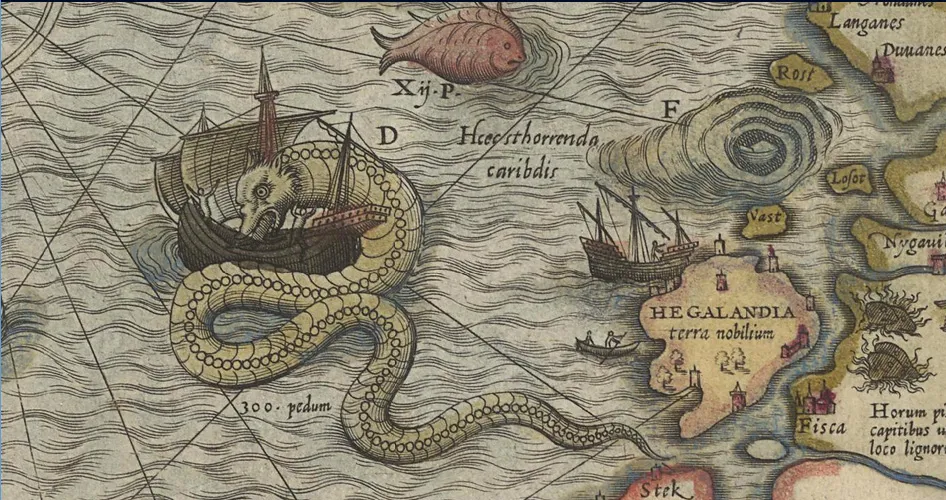
Hic Sunt Dracones
In a sense we have been hollowed out of our own subjectivity. Algorithms, statistics; the whole capital-machine has done away with subjectivity. The subject is in practice made into an object. Its substance, immanent and univocal with all other things, has made it possible for capital to see its qualities and exploit it in an attention economy. We perform labour simply by looking; we are part of an optical paradigm. The body is no longer the link between res extensa and res cogitans; it is a vortex that has inverted Neoplatonism’s great-chain-of-being; instead of a scale from object to divinity, we find ourselves in a post-Kantian hell where the subject experiences its own dissolution in pure immanence—the scale now runs instead from the self outward to the Other, whereupon the body takes the form of a spiral, an axis mundi, from the Self outward to the Other. Yet we are aware, somewhere, that this entire scale is immanent; it is horizontal, in contrast to Plato’s vertical ordering of being.
We ought to feel abjection before our own existence, but the fact is that the postmodern condition has produced a subjectivity that is no longer disgusted by the blending of thing and subject. The eye desires itself as an object and envies the screen its transparency. Abjection has thus been displaced; abjection is not, as Kristeva would have it, a result of our repressed ‘corporeal reality’, but rather of our repressed ‘incorporeality’—it is in the encounter with ourselves (or in the encounter with the other) as subjects that abjection arises; when we have lost our own materiality. For it does not reveal ‘reality beyond the symbolic order’, but rather ‘reality beyond all intentionality’.
This is both an inversion of Lacan and of Husserl. What I mean by intentionality is not only Husserl’s optical origo, where all experience is mediated through an intentional gaze—the object that arises as representation through the direction of consciousness—but also Lacan’s objet petit a; the direction of desire toward an object, the object that stands for the subject’s lost part, cast out from the self into an otherness that must be incorporated. For Lacan, the subject (the ego) is a production that arises in the self’s own encounter with itself as something other; in the mirror stage the child sees itself as an other (as object) and thereby becomes alienated from itself. For Lacan, it is the subject’s encounter with its own materiality that causes this intentional projection toward the desired object.
Deleuze and Guattari were right in their critique of Lacan’s analysis of desire; for desire is affirmative and productive, and not, as Lacan maintains, an expression of a lack in the subject/self. On the contrary, desire arises in the absence of an objet petit a. It is when the subject surrenders itself to its own corporeality that desire as such operates; like a hungering materiality that no longer distinguishes object from subject.
When the eye sees itself as an object, and thus as an other, it is not an alienation from the self that arises. It is an acknowledgement of the inherent immanence of subject and object. The anxiety, or abjection, does not come from the self’s alienation from itself, but from the impossibility of all intentionality—we are back in a crisis of deixis, where all direction dissolves in this immanence. The screen replaces Lacan’s mirror. When the eye sees the screen, it envies its ability to be a pure immanent surface and an object, a machine, at the same time. The eye sees the mirror image of its own deceptive intentionality; its excess. It is not that the screen shows something the eye lacks; on the contrary, it reveals the excess of intentionality and perception. In other words: it is not the subject’s crisis when it sees itself as matter (as in Lacan), but matter when it sees itself as subject, that creates an existential crisis. Matter—the object—in need of a subject, thereby produces, in its reconciliation with the subject, a Self: a sujette petit a. And unlike Lacan’s objet petit a, this is not a projection of its alienation and inherent lack; rather, it is a projection of its own excess; it is something it continually tries to rid itself of.
It is therefore also not surprising that the cure for our deictic crisis may lie in Bataille’s philosophy. It is, after all, Bataille’s base materialism that gives us the only direction we are ultimately left with: death. All meaning is lost in the violent clamour of the sun, and its excess dictates that the only thing we are left to do is to consume. Is that not just such a monster that Western philosophy in the end managed to produce? A schizophrenic capital-body that constantly tries to still its hunger.
The material difference between modernity and postmodernity is ultimately the globalism of the latter; a cessation of terra incognita and a saturated market that seeks the limit of its own growth (and self-consumption). We are, after all, after Deleuze and Guattari, left with a perpetually productive desire. Bataille shows the flipside of that production; its waste and ultimate direction—its end.
But what does all this mean in view of our sujette petit a; that excessive Self that seeks its own destruction? I would argue that it is portrayed in Bataille’s ‘pineal eye’; an eye that, unlike our ordinary eye, does not see horizontally but vertically: straight into the sun’s excessive and violent glamour:
“The eye, at the summit of the skull […] is not a product of the understanding, but is instead an immediate existence; it opens and blinds itself like a conflagration […] The head, instead of locking up life as money is locked in a safe, spends it without counting […] This great burning head is the image and the disagreeable light of the notion of expenditure.” (Bataille, George. The Pineal Eye. Visions of Excess: Selected Writings, 1927-1939)
The pineal eye is thus an expression of what subjectivity is to matter; it is the eye’s desire to annihilate its own intentionality in the same excess. It is thus not a negativity that the pineal eye seeks, but a positivity that affirms its own excess in ecstasy. Could it be our immanent polaris? Is it not the sun that has stretched the grasses, the trees; and the human spine towards the heavens? The sun, laughing at our subjette petit a, which annihilation we desperately pursue.
Oedipus here becomes a kind of parody of matter’s own subject. With pride in his sharp-sightedness and belief in his subject’s agency, the encounter with his true fate resulted in autoenucleation; his metamorphosis and final function became his own blindness, this coming as an ironic punishment concerning his blindness to his own direction.
Where Lacan re-enacts Oedipus, it becomes clear here how our anti-Oedipal reversal of Lacan in fact elevates Bataille’s pineal eye in Oedipus’s place. Where Oedipus gouges out his eyes as a result of his own blindness to himself, we fill our pineal eye with its own excess in ecstasy; in ecstatic affirmation, in order to expell subjectivity from matter.
The narrator in Lovecraft’s Polaris might be our anti-Oedipal anti-hero; he himself exemplifies the sujette petit a, for he is but a small subject simply defined by his keen eyes, thus he was granted the task of being the eyes of the army. Placed in the watch-tower, he is being haunted by Polaris granting him a promise:
“Slumber, watcher, till the spheres
Six and twenty thousand years
Have revolv’d, and I return
To the spot where now I burn.
Other stars anon shall rise
To the axis of the skies;
Stars that soothe and stars that bless
With a sweet forgetfulness:
Only when my round is o’er
Shall the past disturb thy door.”
Completely disoriented the narrator condemn this pale star that is penetrating him with its gaze; the star that should be a fixed point of navigation instead puts him in a state of never knowing if reality is merely a dream or not; making the distinction between waking and sleeping life impossible. He is thus stuck in two immediate here that is irreconcilable.
Meanwhile: this promise makes his duty as an eye superfluous—excessive because he is stuck in an eternal recurrence of his failure as a subject, unable to locate himself. His fate is not that of Oedipus—whose destiny is to be blind to his own direction—but that of an eye that is cursed to excessive seeing. The narrator in Polaris is thus forced to fall asleep (to reach his own limit as a subject), and constantly fail his duty as an eye while facing the eye of immanent being itself. What Polaris does is that it forces him to watch his own watching, and as a devastating result, his keen eyes are turned back on themselves—and in that reflexive loop, he discovers his excess: that there is always more seeing than there is object to be seen. This is the surplus of intentionality over its correlate, the noema overflowing every noesis, that desire tries to expell but can never really exhaust. The narrator, in being forced to see his own seeing, becomes the sujette petit a. His duty is not to see the enemy but to be the pure function of seeing. And since Polaris already fulfills that function cosmically, the narrator’s seeing is pure excess, waste, a Bataillean expenditure that serves no strategic purpose. The curse of eternal recurrence is that he must burn with this excessive seeing forever, just as the star burns. He is not punished with blindness but with the impossibility of ever closing his eyes ontologically.
The irony of this promise lies in the North Star’s dual function; it is both the symbol of an origo and an eye (both object-as-point-of-intentionality [gegenstand] and subject-as-actor-of-intentionality) that makes all other eyes superfluous. It grants subjectivity the gift of eternal recurrence and its repetition is the grantor of his own redundancy. But what also returns is the very question of deixis. The narrator is only left with Polaris as a guarantor of this promise, that is, his only fixed point of reference. A point of reference that rob him of the answers of the very question that it guarantees. Thus; the past that disturbs his door, is precisely the impossibility of settling the deixis.
What follows from this inversion with regard to our inability to create a language for our own navigation? We have already identified that the problem is fundamentally optical; in order to orient oneself in time and space, it presupposes that we can see at all. The eye as a concept has given us a language to go beyond optical lenses and the postmodern excess of perception. The question is thus not how we can find the right perspective; but rather how we can encounter pure immanence on its own terms. The excess of perception is, at bottom, the eye’s inherent conflict with itself; it presupposes that the only way to produce a language for this immanence is by affirming this excess. Bataille gave us a language for ecstasy, but in the end it is perhaps a new subjectivity that ultimately shows the trace toward a new grammar. It is ironic that the Enlightenment craved a new kind of objectivity, while we now, rather, crave a new kind of subjectivity that goes beyond itself. A subjectivity that can both affirm itself as redundant, and at the same time use its own excess to become something more than subject.
If the eye desires itself as an object and envies the screen its transparency; is there an origo in its blind spot—in its impossibility of becoming an object; of becoming pure matter? We return to Nietzsche, who sees human subjectivity as something that must be overcome: the very distinction between object and subject, between other and self—this distinction must go through itself to become something beyond both object and subject and thereby affirm its own immanence. Deleuze gives us a concept: a life. But the answer I seek is something else—it is the step beyond becoming, and thus a language that can finally be differentiated with its own affirmation, while at the same time going beyond its own differentiated state: an Übergegenstand. That is; the object that has overcome its transcendental relation towards a subject and thus gotten rid of intentionality as such.
The only direction I can identify in this disoriented position is the position’s own limit; is this not the literal function of Lovecraft’s pale North Star? Our anti-Oedipus, stuck in the eternal recurrence of his own redundancy, can only obsessively see his failure as an eye through the eye of this pale star (the immanent object whom makes the subject its object). I have cried out for a new deictic grammar; but this grammar is itself absent from the position I find myself in. Yet through this very limit I have posited—Übergegenstand—the question that my entire saturated text has posed from its inception remains: “where am I?” This question demands an answer. And the only answer I can give is that I am “here”; and this here is situated in pure immanence—in the indexicality of becoming itself. How can we identify the direction of pure becoming? Let me attempt a leap of thought—it is, after all, the whole of everything that is at stake, so why not try something potentially idiotic?
If we assume that the concept Übergegenstand is the direction in which a new deictic grammar becomes possible, then this concept occupies a position analogous to the limit value of a function defined on a punctured neighbourhood of .
Let be the deictic point I seek; the “here” from which all grammar emanates, but which is itself excluded from the domain. This is the position I can never occupy, the point where the subject would be fully transparent to itself.
The function is then my finite utterances, my approximations of being, defined for all in the punctured neighbourhood
where (delta) is the radius of the linguistic range within which my utterances hold validity. That the neighbourhood is punctured precisely means that itself—pure immanence, the indexical “here” that can never be stated without already having fled from itself—is never included.
And yet, from within the punctured neighbourhood, I can identify a direction. This direction is not arbitrary; it emerges as the one-sided limit
,
or, if becoming moves from the not-yet-being toward the already-being
.
If these coincide (if ) then the full limit exists:
,
and this is precisely Übergegenstand: not the point itself, but the value that the function approaches arbitrarily closely as approaches , under the unyielding condition that .
Thus: Übergegenstand is , the limit value of the new deictic grammar. It is not the position itself, for the position remains indeterminable, absent from every possible utterance, but it is the meaning that emerges as the function’s final direction.
Every question “where am I?” is an in the punctured neighbourhood; every answer “here” is a function value ; and what makes the repetition of the question meaningful, what guarantees that the answers converge rather than diverge, is that
.
The indexicality of becoming itself is thus nothing other than the structure of the punctured neighbourhood viewed from within: an infinite movement toward a point that is never reached, but whose existence as a limit value is the only thing that gives the movement its direction.
What this leap of thought reveals is the following: If the limit exists, what guarantees convergence? That is to say: what is it in immanence that guarantees convergence? Maybe it is the very excess of subjectivity—sujette petit a—that is that guarantee; the eye that keeps on trying to localise itself by the very question of its being. It then would follow to ask, how, in this situation, we can guarantee convergence between rival utterances, not how we can guarantee a truth-value between rival utterances. We are left open with this question for now; it deserves its own answer.
Here is my hubris. And my divine punishment is that I am left with convergence as the only means of finding direction in my own existence. Am I now condemned to constantly ask this question “where am I?” in order to have any hope at all of finding a direction through the very difference of the question against its own repetition? The eternal fucking return… How ironic. The french have a phrasing for it:—rire jaune, a yellow laugh that knows it has gotten caught. For, in some sense, I have become a parody of Descartes; whose fate is to eternally return to find its origo by the very act of questioning. But where Descartes finds his origo in his cogito; the only punctum firmum (and confusing this event with yet another substance); the only here I can ever possess is the punctual moment of my own collapse as a cogito. And yet, I applaud the emergence of this cul-de-sac. What a sweet gift you have given me, Polaris.
author's final note: "This is just Derrida in the costume of a mad tranny, isn't it? fml"