“My spirit drives me now to sing about
Ovid, Metamorphoses, Book I
the forms of things changed into new bodies.
Since you gods caused these transformations, too,
inspire what I am going to write about,
and bring forth an uninterrupted song,
from the primal origins of the world
down to this present age.”
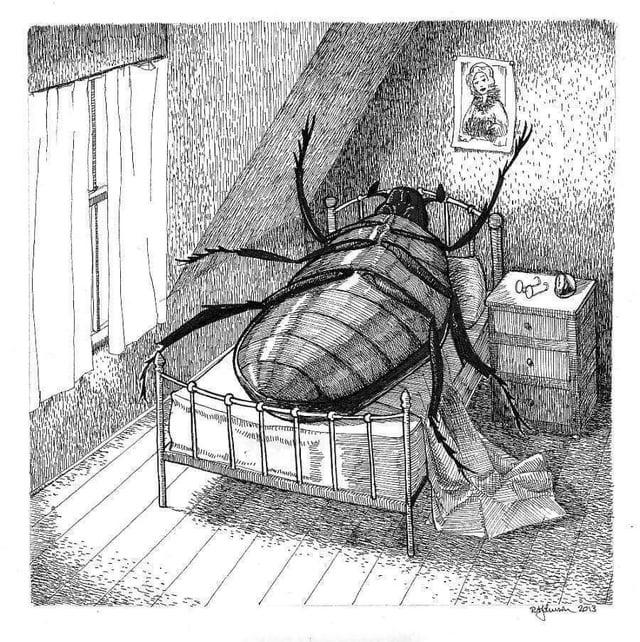
“Als Gregor Samsa eines Morgens aus unruhigen Träumen erwachte, fand er sich in seinem Bett zu einem ungeheuren Ungeziefer verwandelt. [One morning, as Gregor Samsa was waking up from anxious dreams, he discovered that in bed he had been changed into a monstrous verminous bug.]” (Kafka, Franz. 1915. The Metamorphosis). Gregor had already opened himself to the transformation without knowing it. He had achieved a kind of alchemical miracle; it is not difficult to imagine a red shimmering light beneath the night in which the transformation occurred. Rubedo! Rubedo! The sun shone like an atomic bomb. It brings the mind to blood. To use Bataille’s own words in Blue of Noon: “Was there anything more sunlike than red blood running over cobblestones, as though light could shatter and kill?” (1935).
In another plateau I have already introduced the concept of imago. But where I previously took my point of departure in our shared death, there is so much more to say. There are in fact two aspects of the concept that I want to highlight: (i) becoming and the concept’s place in a revolutionary aesthetics, and (ii) the concept’s relation to an ephemeral imaginality. In line with my entire project (and ADHD brain), I will not follow a linear argument below. I am tired of trees and indifferent logic. I want to sing you a song from the primal beginning of existence itself and thereby also open the door to the imaginal. A door like in Strindberg’s A Dream Play (1902); and I pity all the right-thinking for their disappointment at the nothing that lies behind it.
Thus, to return to our beloved Gregor Samsa, his transformation carries a kind of inverted philosopher’s stone. There is a folded distinction here between what Deleuze and Guattari call “a minor” and “a major” literature. We may imagine Dante’s snow-white rose in Paradiso as representing the major form of the final alchemical process, while Gregor Samsa’s transformation mirrors the corresponding minor form. In Deleuze and Guattari’s Kafka: Toward a Minor Literature (1986), the concepts diverge: a major kind of literature territorializes language; it totalizes it and binds it into an overarching whole. A minor kind of literature subverts language; it deterritorializes it and thus acts as a resistance against language itself. Thus, what a traditional alchemical transformation does is a kind of individuation of the self; the philosopher’s stone totalizes the self and incorporates its opposites into a unity. The self becomes territorialized by itself. Gilgamesh’s journey toward self-realization, to attain immortality and thus access the philosopher’s stone, is an expression of this form of process. To encounter death and incorporate this one’s own death is undoubtedly a kind of territorialization of our own brokenness, but it is a totalization that is impossible; brokenness itself makes it impossible for the self to become whole. Kafka’s metamorphosis exemplifies this distinction better; for it is through a radical deterritorialization that the insight of death occurs. One’s own death makes us flee from the self; the self’s own incompleteness drives it beyond itself, into new openings and lines of flight. This is the dark side, or the minor philosopher’s stone. Gregor Samsa’s transformation is in many ways violent in this respect. His total shame and confusion, and his family’s inability to deal with his new form, arise from his imago; he had become an alien even to himself.
It should also be noted that the German word “Ungeziefer” (vermin) etymologically means “animals unsuitable for sacrifice” (https://en.wiktionary.org/wiki/Ungeziefer). In Bataille’s reading of Hegel in Hegel, Death and Sacrifice (1990), he shows how Hegel’s sacrifice is humanity’s expulsion of the inner animal; the inner beast. In a way, Enkidu’s death became a sacrifice for Gilgamesh insofar as Enkidu, the wild man, represented Gilgamesh’s own death. This being-toward-death that emerges within the human is revealed for Hegel precisely through the animal in sacrifice; it reveals the human as a life lived from death. When the animal is killed, the self identifies with this animal and sees itself disappear with it. But this “Ungeziefer,” this pest that arises in imaginal metamorphosis, does not conceal death behind a veil as in monumentalism; instead, it allows itself to be identified beyond the dialectic between human and animal, master and slave, as an alien. It sees the joy in death (what a liberation that even others’ memories of me will disappear in the sands of time!) while at the same time carrying its melancholic sorrow at becoming a trace in the desert of existence, which will nevertheless be blown away into oblivion. For it is a pest in the sense that it is not meant to be sacrificed; it carries its own negativity and incompleteness without the need to resolve this immanent instability.
In Ovid’s Metamorphoses, Book VI, the young woman Arachne challenges the goddess Minerva to a weaving contest. Minerva weaves an artwork, an image, of divine order and its splendor, along with warnings of what hubris leads to. Arachne, in turn, creates an image of the gods’ violence, the consequences of divine power, and she sanctifies difference in itself; the new over the old. Her images of the abuse of divine power I read as imago. Where Minerva seeks to maintain the status quo and totalize the singular power of divinity over existence, Arachne seeks liberation from it; she seeks something new and thus defies the very conditions of existence itself (the gods read as representatives of these conditions). Arachne’s hubris is not remarkable in the sense that she sees herself as unbeatable and uniquely superior, as an expression of narcissism. On the contrary: her hubris is an expression of her will to freedom and her will to flee from herself as much as from the tyranny of the gods. This very hubris becomes her downfall because of that will. It is through her own Magnum Opus that she opens the door to imago; a transformation that, like Gregor Samsa, turns her into a pest—in her case, a spider. Ovid’s words should also be illuminated here: “The girl, now desperate, could not endure the blows [of Minerva], and, in a burst of courage, fixed a noose around her neck.” (1892). Her art drove the gods to violate her to the point that she committed suicide “in courage.” Her courage to follow her own line of flight thus became her own ecdysis into imago. In a way, she collided with her own negativity in a becoming-spider.
Just as Deleuze and Guattari observe in Kafka: Toward a Minor Literature (1986), the minor transformation does not arise from the minority’s self-transformation; it arises from the majority’s. Just as a minority writer produces a minor language within the major language, the minor philosopher’s stone arises through the greater rubedo process. And just as the impossibility of not writing creates the conditions for a minor literature, the same conditions for imago arise through an impossibility of becoming-majority. It is with Minerva’s own art form, weaving, that Arachne defeats her. But she must weave; the impossibility of refraining is the very condition of her so-called “hubris.” Thus, it is from the starting point of the old that openings exist—the doors that release what rots and welcome the arrival of the new. The very impossibility of finding the new in the old is our door to the new.
“Writing like a dog digging a hole, a rat digging its burrow. And to do that, finding his own point of underdevelopment, his own patois, his own third world, his own desert.” (ibid).
Ballroom culture was an imago winged like a butterfly. Vogue dance reveals an important aspect while exemplifying the criterion of impossibility; by imitating the images of Vogue magazine, the queer desire to attain the same majority status represented by its models was liberated. Through this impossibility of territorialization, a radical deterritorialization of the simulacra that Vogue totalized instead emerged. Here a new distinction awakens: that between imago and simulacra.
What exactly is an image? This is a rhetorical question. The image of the image as representation of reality has already been painted by Plato and Aristotle. Mimesis I take here as this image of the Image; a photographer photographing a tree, a selfie, a sketch of an idiot. X is an object and Y is a meme of the object, a representation. Dionysius’ imitatio, in contrast to the concept of mimesis, presupposes an ability to go beyond the image of the object; where the representation is not tied to the object itself, but to the image of the object. Imitatio imitates the representation of an object itself and can thus be seen as a higher order of image, where the image is not only an image of an object, but also an image of an image that depicts an object. Ah! Appreciate my humor, my companions! (That is an order).
But in the highest order of images we have simulacra. Baudrillard writes in Simulation and Simulacra (1994):
“Such is the successive phases of the image:
it is the reflection of a profound reality;
it masks and denatures a profound reality;
it masks the absence of a profound reality;
it has no relation to any reality whatsoever: it is its own pure simulacrum.”
Simulacra are thus images whose object is a reflection of themselves. It becomes clearer still in Baudrillard’s opening quotation from Ecclesiastes:
“The simulacrum is never what hides the truth—it is truth that hides the fact that there is none. The simulacrum is true.”
In a world of memes there are only memes to make memes from. We live in a time where every image we encounter on a screen risks being AI-generated; every piece of media is its own Orphic trap: “Like Orpheus, it always turns around too soon, and, like Eurydice, its object falls back into Hades.” (1994). What remains are not objects, but simulacra in a web of learned associative patterns. An image is thus not only representation but imagination. And how their content is coded depends on how these associative patterns are arranged in a web of semantic meaning.
What is a woman, really? This is a rhetorical question. A trans woman sees herself in a self-portrait; she experiences the violence of associative patterns upon her body. She experiences an impossibility; an impossibility of reproducing her own body within a majority image. Where Vogue imitated simulacra from fashion magazines, she imitates woman. What distinguishes her from a cis woman is that the cis woman imitates a majority image of a mannequin:
“To be castrated is to be covered with phallic substitutes. The woman is covered in them, she is summoned to produce a phallus from her body, on pain of perhaps not being desirable. And if women are not fetishists it is because they perform this labour of continual fetishisation on themselves, they become dolls. We know that the doll is a fetish produced in order to be continually dressed and undressed, dressed up and dressed down. It is this play of covering anduncovering that gives the doll its childhood symbolic value, it is in this play, conversely, that every object- and symbolic relation regresses when the woman turns herself into a doll, becomes her own fetish and the fetish of the other. Freud says: ‘pieces of underclothing, which are so often chosen as a fetish, crystallise the last moment of undressing, the last moment in which the woman could still be regarded as phallic.” (Baudrillard, Jean. 1976. Symbolic Exchange in Death.)
The trans experience is an imaginal metamorphosis in this respect. And here the concept of imago reveals its full face: it is a subversion of simulacra that arises in the deterritorialization of images. Becoming-woman is, in itself, according to Baudrillard’s observation, its own transformation: to become mannequin. The impossibility of becoming Marilyn Monroe creates its own imago. TERF logic, which sets trans women and cis women against each other, has gouged out its own eyes; it does not see the image of woman itself for fear that this same image will be deterritorialized. Becoming-mannequin is itself an imago; the trans woman castrates herself in order to carry her own phallic substitutes. The mannequin does not mask any truth: it is its own truth. Where a caterpillar is merely a mask for its true form as a butterfly, its imago is an unmasking.
It is in this that I also unmask imago as a concept; I repeat: where a caterpillar is merely a mask for its true form as a butterfly, its imago is an unmasking. It is in a confrontation with one’s own impossibility, one’s own negativity, that imago arises. It is not merely a flat wabi-sabi logic that follows from this metamorphosis; it is an imitation that imitates neither human nor animal. It is an imitation of a pest; that which cannot become sacred. Ecdysis is thus an unmasking of the majority’s simulacra:
“Animals have no unconscious, because they have a territory. Men have only had an unconscious since they lost a territory. At once territories and metamorphoses have been taken from them-the unconscious is the individual structure of mourning in which this loss is incessantly, hopelessly replayed-animals are the nostalgia for it. The question that they raise for us would thus be this one: don’t we live now and already, beyond the effects of the linearity and the accumulation of reason, beyond the effects of the conscious and unconscious, according to this brute, symbolic mode, of indefinite cycling and reversion over a finite space? And beyond the ideal schema that is that of our culture, of all culture maybe, of the accumulation of energy, and of the final liberation, don’t we dream of implosion rather than of explosion, of metamorphosis rather than energy, of obligation and ritual de fiance rather than of liberty, of the territorial cycle rather than of . . . But the animals do not ask questions. They are silent.” (Baudrillard, 1994).
We have lost the beast among all simulacra, but imago is not here a rediscovery of the old (of the beast); it is a creation of the new (of the pest). Simulacra are, in this sense, the very door to imago. It is through simulacra that we can hatch our cocoon and open our wings as a new kind of monster. The point (if there even is one) is not to create something that survives, but to create something dying, something limping, something allowed to pass. Vogue dance has once again been territorialized into the majority via Beyoncé. It was never a question of creating an image that survived. Our way of surviving was to allow ourselves to be grateful like the dead; that we could break free like butterflies with open wings toward the new and pure difference.