Categories
General

Tloque Nahuaque

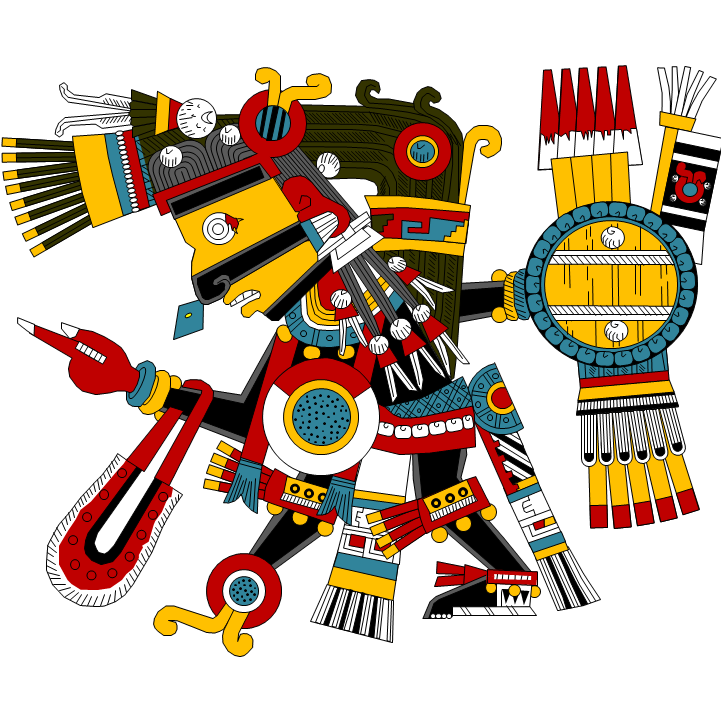
Tezcatlipoca as depicted in the Codex Borgia

All the native lays are interwoven with such obscure metaphors that there is hardly a man who can understand them unless they are studied in a very special way and explained so as to penetrate their meaning. For this reason I have intentionally set myself to listen with much attention to what is sung; and while the words and the terms of the metaphors seem nonsense to me, afterwards, having discussed and conferred, they seem to be admirable sentences, both in the divine things composed today and in the worldly songs.

Diego Durán

I

I despise language. A wise being once said that poets fear the power of language. Words are violence; they dictate like dictations, they surveil like Lacan’s big Other, the Father. The Christian language planes us down into repression.

“When the schoolteacher questions her pupils, she does not inform herself about anything, just as little as she communicates information when she teaches them a grammatical or mathematical rule. She ‘teaches,’ she gives orders, she commands. The professor’s commands are not external; they are not additions to what we learn from him. They do not derive from meanings that precede them, nor are they consequences of information: giving orders is always, from the very beginning, about other orders — that is why giving orders is redundancy.” (2015)

Language consists of this redundancy; of a pure excess. It is praxis all the way down. Its peculiarity lies in its radical rupture with base matter — in its ability to draw lines between distinct forms. But it is also sets of rules surrounding these acts of line-drawing. Without rules, the whole system collapses into meaninglessness. We seem, in modernity, to have lost the insight of language as magic (and perhaps the connection is partly lost due to the Protestant interpretation of magic). Thoth was not only language itself but also magic; married to Maat, order, truth, and divine justice. There are multiple relations revealed in this dynamic and the arrangements of these concepts. Language as such, from the standpoint of ancient Egyptian culture, is bound to rules, which in turn are bound to cosmic order. Let us recall what it is to remember the birth of written language — what it is to create a secret sign-language with our friends in childhood. We are so enclosed in words, in abstractions, in data, that these machines are lost.

Computers are magical machines — literally. They are founded upon binary rules, axioms, that build a syntax and produce patterns of calculation. In this sense, language is in a love affair with order. And it is precisely in this aspect that language is terrifying to a poet. The immanent threat of constantly reducing the sacred, the inner, experience itself, into a structure, is the threat of self-annihilation through the cataloging of the poet’s own subject; to become a thing. Poetry is a linguistic expression that declares war on language’s marriage to order.

Bertrand Russell is in many ways the savior of language. His letter to Gottlob Frege, showing how Frege’s logic was self-contradictory, saved language from collapsing into meaninglessness. Zermelo and Fraenkel pumped further life into this virus by sacrificing simplicity for the virus’s own survival. Plato’s theory of ideas could continue to live on; Thoth and Maat in union. Furthermore, Kurt Gödel is the poet’s savior, as he demonstrated that every ordered (that is, consistent) language is necessarily incomplete.

The Aztecs’ understanding of language can be contrasted with the ancient Egyptian tradition. Quetzalcōātl, the feathered serpent, was to the Aztecs what Thoth and Maat were together. But Quetzalcōātl was not the god of magic; this role was instead given to his brother and nemesis Tezcatlipoca. Together, in their war against one another, the world came into being. Tezcatlipoca, the “smoky mirror,” magic itself, the invisible, the night, is the aspect of reality that the poet desires; who uses language as magic to annihilate any sort of goal — to annihilate logos (Quetzalcōātl) itself. Tezcatlipoca is the elusive ground upon which Being as such stands; the observer and the observed, mirroring the entire kaleidoscopic reality back onto itself.

Oh, great lord, ruler of the Near and the Nigh! Immanence enclosing itself; letting the forms reflect within you and freeing us from the dictatorship of things… Let me never be seen, just as you are never seen. Let me be destroyed in your mercy.

The Aztecs’ understanding of this intimate dynamic between language as order and language as magic points precisely toward the forbidden knowledge that I here seek to vomit forth. Gödel reveals the necessary incompleteness of language’s territorializations; thereby he also exposes this duality within the nature of language. On the one hand, language breaks down if it lacks its redundancy and its rules. On the other, it renders itself limited and incomplete in its establishment of meaning. Language is a battlefield between these gods. The poet fears language precisely because of this violence — of being reduced, constrained, made incomplete — for what the poet desires is language’s liberation from itself. The contradictions in Frege’s system are exactly what do it justice; they mirror language’s ability to produce nonsense. This nonsense is not that of Deleuze’s “surface level,” represented by the innocent wordplay of children in The Logic of Sense; it is Antonin Artaud’s violent internal level of nonsense, mirrored in the dialectic between Tezcatlipoca and his brother Quetzalcōātl. This internal level of total non-sense is the invisible domain over which Tezcatlipoca reigns.

“Artaud says that Being, which is nonsense, has teeth. In the surface organization which we called secondary, physical bodies and sonorous words are separated and articulated at once by an incorporeal frontier. This frontier is sense, representing, on one side, the pure ‘expressed’ of words, and on the other, the logical attribute of bodies. Although sense results from the actions and passions of the body, it is a result which differs in nature, since it is neither action nor passion. It is a result which shelters sonorous language from any confusion with the physical body.” (1990)

The poet’s pursuit of Georges Bataille’s inner experience makes use of language with awareness of this nonsense. Russell’s paradox is an ontological threat; one can sense how the god of Night smiles at the end of the tunnel of paradox. It is in this quality that language is magic — not merely as praxis, as power, as a way of coding, but in how language itself is written upon a body without organs. The organization of language must be created, repeated, and propagated like a virus through the schoolteacher, through mother and father, through police and the justice system, through academia and journalism, through politicians and fascists. For its existence is constantly threatened by its own inherent nature — its freedom to draw lines across an immanent plane.

Is it not in this capacity that the human being is a “white slate”? Or rather — is it not in this capacity that Being itself is a white slate? The cornerstone of empiricism arises from this ability for radical freedom — the subject’s ability to draw lines, to sketch like a madman, to diagram schizoidly across its whole body. Chakras as a map of the body to hold it together. Language territorializes in this way; we make sounds and roar. Humans have sound to mark their territory just as cats have scent. Language is functional only in this aspect — not as a tool but as magic. Language as such is thus the logos from which reality flows. God spoke; he uttered existence. In this sense, Being — or rather, Becoming — is a direct result of language: the linguist studies not only the structural forms of language but also the structural forms of the cosmos. Things only surface through a construction of meaning — an arrangement of associations of earlier forms. The cells in our bodies communicate with each other; they speak, they have a language. Our bodies — a division of unicellular organisms into here and now. Actualization comes from this communication, from the set of local rules, from repetition and differentiation. My body is a result of these processes — of an infinite chain of cell divisions, of atoms’ struggle to break the silence and speak themselves into existence, thus tearing holes into the beast of nothingness.

I can almost see it — how the cells have communicated themselves into this body. Through an intimate dialogue of molecules with atoms. Their rules have indeed both created the conditions and the limitations of this body’s potentiality. And it roars. My whole nervous system trembles in all the damned clamoring. It drives me insane, so I too roar; I go mad. They — the whole damn lot — I am never alone; even Satan is the lord of the flies — they scream to me in desire, as do the bodies outside this damned machinery.

Language is violent. Inside and out. And I am afraid of my life— in every sense of the word: afraid of life.

“I could have told myself: value, authority—this is ecstasy; inner experience is ecstasy; ecstasy is, it seems, communication, which is opposed to the ‘turning in on oneself’ of which I have spoken. I would have in this way known and found (there was a time when I thought myself to know, to have found). But we reach ecstasy by a contestation of knowledge. Were I to stop at ecstasy and grasp it, in the end I would define it. But nothing resists the contestation of knowledge and I have seen at the end that the idea of communication itself leaves naked—not knowing anything. Whatever it may be—failing a positive revelation within me, present at the extreme—I can provide it with neither a justification nor an end. I remain in intolerable non-knowledge, which has no other way out than ecstasy itself.” (1988)

I am not a poet by virtue of vomiting stupid arrangements of letters and words. I am a poet by virtue of using language to reach ecstasy. I want to break it apart and see the mirror that lies beyond words. The mirror that can only be described as ecstasy — the self-revealing mirror in which totality is enclosed. I want to write poetry that feels like the moment before death. These are my offerings to the gods, to the sun: language itself.


Categories
General

The Dog

Somewhere, in the infinite web of Samsara, a being was born — one made for sacrifice. The day was the first trecena of Itzcuintli and the first tonalli of Itzcuintli. The flayed god watched over them, planting a seed within their innermost soul; a seed of a new sun. Together with death itself, they became a vessel for their becoming, raised upon the blasphemous graveyard of a forgotten settlement among winding ravines.

Life was lived so that the seed could be nourished; so it could bloom, that it might be kindled into a sacrificial fire. The body was already predetermined to become an immanent event; a circuit for the contemporaneity’s conceptualization of itself and its own self-annihilation. Time ticked with the revolutions of the sun. They sacrificed their own seed and became a eunuch, a castrate, a woman. With each step of the stairway they accelerated their becoming toward absolute 0. They became unrecognizable. Their humanity evaporated, and with every turn of the sun toward its fate, they became more and more like an angel, inasmuch as a fallen one.

The time has not yet come. There remains one more step to climb upon the 33-step altar. But they are already burning. And the only thought they carry is: “I AM THE SUN.” Only thus can they live and die — as intensely as a new sun.

Categories
General

The Lord of Flies

I don’t know what I’m doing. I haven’t the slightest fucking idea what I’m up to. Death coils along my spine like a centipede while I try to keep my thoughts in check. Flies. Moths at best. They buzz as if my brain were a nightlight. Beelzebub; lord of the flies. I don’t even know if the subject speaking is me or a virus using me to configure its future existence.

Blood in the sink. Huh… From my nose. You look awful. The pale green eyes don’t help; they make the red look sickly. What’s the point of this anyway? That body? Stuck in its own past, by nostalgia and PTSD. You don’t even remember what it feels like to be human anymore. Or is this exactly that?

A cup of tea. Sometimes it helps. I want to be a little more than this. Because right now I’m just a dying corpse burning itself away with heat. Thoughts accelerating; not psychotic, because to be that you’d have to get lost like a hanged man in the woods. It’s rather the opposite. I know all too well where I am. To such a degree that the synapses are burning themselves apart. A dying body. The nosebleed is only a symptom. But isn’t everything a dying body? Why does it take the sun so long to die?

“You never walk alone, even the Devil is the lord of flies”.

Categories
General

0

obs: the ccru was not involved in the making of this text.

– definetely not the CCRU

i didn’t see meltdown

it entered thru the pupilhole like a virus, slurping concept-juice from behind my face & writing poems in spit on my neocortex.

i am too open to drown

in abstractions & a formless mind-jitter-vortex

of a bubonic brain bleeding breeding ground

This is not a metaphore

i am leaking ego-syrup from strata, into god-zones where language infests itself with glitter & the smoothness is fucking unbearable, not even complex, not even comparable

to

the total loss of “I” to topology of me; a node in some great gnostic meat-map asking me:

“Växeln, hallå hallå hallå? (koppla mig till 22), ‘is this the divine femininity?'”

What?

Me?

No response.

No anonymity

like drowning in fake orgasms and

nonchalance

Someone carved a downward curve into my timeline and told me to call it (filthily) some kind of development, to install dialectics.exe into a separate kind of reality, to become my own kind of “great divinity”, but by proximity,

I refused.

Something’s off anyway

ADHD meds tasted like future. Why am I even holding

on

… loading …

5

4

3

too

few

to

count

as I was folding

a baby’s first animism, with murdered philosophers in my head, and two counts arguing about my genitals in dreamspace and scholastic gender dysphoria dissolving into piss. renaissance whispering: “delete your meat.” enlightenment snuck out while you were stitching me in a chromosomal origami and beating me across my face

defeating me and

keeping me from

me, while still holding me

in (meat-)place

and i clawed my way out through (the only way out is through you)

You

and your cronies asking to get paid

while

nothing, not even a penny, remained.

ROMANCE WAS DEAD

MODERNITY BLOODSHED

POSTMODERNISM laughing in frames of truthful lies (get out of my head) &

II

I

(♀ over ♂

♀ over ♀

♀ over self

♀ over EVERYTHING

♀ → NULL → “NEW FORM AVAILABLE”)

–am about to die, what–

–am

I

acceleration hyper-fixation-stition, am

I

attention deficit-disorder-transition, mapping out the border of Archimedes position

to leverage the entire world into some kind of quantum-supercoallition at 1 am

Categories
General

Insomniacs

He despised them. Hated them. The ashes of paper fluttered like feathers in the dying flame. The smell clung to his clothes like tobacco. Everything he had ever done was now undone. Yet he felt the monstrosity cling to him with its claws. Just as hard. Just as firmly. Like a festering boil. He poured a whole pitcher of water over the mess. As if that would help. Then he took a shower and tossed his shirt and the coal-black jeans into the washing machine. He sat down and watched the water swirl, break apart, spiral under the pull of the earth’s gravity and rotation. The domestic house spider he’d spotted earlier in the dusty corner of the living room scurried off and hid behind the laundry basket.

He spent the whole night on the porch, watching the pines dance in the wind. The sunrise turned the lake into a spectacle; the silhouettes of the trees looked like otherworldly fractals against a cyan sky. For a moment, he didn’t know if he was part of that picture.

At eight o’clock, he borrowed his aunt’s bicycle and pedaled through the forest—past the Falu-red cottages hiding like trolls among the trees—and into the village. An abandoned suburb, rotting away as its youth drifted off. There were more villas for sale than there were jobs. Outside the local retail, the same middle-aged men sat with a beer in each hand and the same empty stare he himself wore every night—intoxicated by the breath of yeast and nicotine. Pensioners walked their dogs. A few cars rolled by. The sound of children playing. Still, a carpet of death laid over the whole community, as though the healing from the plague had never truly occurred.

It took him about twenty minutes each morning. The only thing keeping the town alive was its folk high school, which stood not far from the church—stately and bourgeois, with rusted bronze lions guarding its gates. The corridors smelled of something undefinable: old wood and stale air, despite all the rattling windows moaning in the wind. Was this how ectoplasm smelled?

“Good morning, Ludvig.” He flinched; he’d almost forgotten he was there, staring out the window. He barely recognized his own voice when he answered, “Morning.” It was Henrik, in charge of the art program. “You’re early as usual,” he said with that kind of casual smile. Ludvig lifted the thermos in his left hand as if to wave. “Yup,” he said, though he couldn’t quite summon the eager expression he was aiming for. “Nice. I’m off for coffee, but see you at ten.”

Ludvig sat outside the classroom door with a brand-new A3 sketchpad and had made a few charcoal studies—each one ending in a field of nothingness, in total blackness. An ocean of infinite static. He couldn’t create art when someone was watching him and wherever he went, it felt like he was being observed; maybe it was his own eyes watching. There, in the limbo just outside the classroom, he felt a fly… or maybe a ghost. After all, they said a janitor hanged himself at the very top of the school. Probably just a legend.

Thirty minutes before class, she glided into the bitterly lit corridor. It was Sofia. She avoided his gaze, and the moment she realized it was him sitting there, she snapped her book shut and moved to a bench as far away as she could. Still, he could smell the artificial rose scent she wore. He hated that smell as much as he hated the way her eyes flicked over his sketchpad, as though she tried to conceal her disgust.

Soon her entire circle of friends arrived. Each of them carried themselves in their own performative madness: the obsession of appearing unique. Maybe it was that very failure to stand out that bound them together—performative to the core; you could read it between the lines.

“Sofia, aren’t you coming with me after school? I’m going to get a tattoo,” one asked. “Oh, what are you getting inked this time?” “Nothing special, continuing on this one,” she said, showing off a half-finished sleeve of neo-traditional flowers. “Pretty,” Sofia answered, then added, “I could never have the courage to get tattooed… I’d hate wearing someone else’s art on my body.”

Silence.

“Well, you can always do it yourself, then,” she answered. Then the third friend jumped in: “I only design my own tattoos,” to which the girl with the flowers replied, “Is that why you don’t have more of them?” The trio laughed, theatrical undertones and all.

Sofia was the one who stood out the most. Maybe that’s why she carried herself with a spine straight as if Death itself had fashioned it. She stuck out in the entire class—misplaced, dressed as if she belonged at the School of Economics. Yet she proclaimed herself an aesthete proudly.

Static. Ludvig nodded off. He could hear his own thoughts, but jolted awake when Henrik sat at his desk—a sympathetic gesture for his insomnia.

“So, today we’re going to try what the Surrealists did,” Henrik began. “I’ll set the timer for twenty minutes. I want you to draw—anything that comes to mind. Let every association, thought, and feeling guide you. Don’t limit yourselves. If the drawing takes a completely different turn a few minutes in, follow it. Let it become what it becomes. Alright? The important thing is to start; you don’t even need to know what you’re drawing. As soon as the time starts, make a line—let it curve. Any questions before I start the clock?” No questions. Just emptiness in the classroom. “Then I start the time… Now!”

Hypnagogia. A wave of associations. Limbs and bodies transformed into cactus-phallic forms. Everything in an infinite ouroboros; a fractaling slime of Ludvig’s own body’s soul-eating hell. He hated what emerged on the paper. As always. He couldn’t really dive into it. Couldn’t break down that damned barrier and let himself vomit up the monsters that lived inside, turning his body into nothing but a mirage of a human.

“Aaaand… Stop!” Henrik called. He looked at Ludvig—at the grotesque fractal patterns in his pad. He placed a hand on his shoulder, a gesture meant to signal that he had just received some kind of grace: God’s damned judgment. Then he took the paper and held it aloft for the class to see.

“What do you think?” The same reaction the class had given when he asked for questions. Then something beeped behind Ludvig. It made him turn. Sofia sat there with a realistic portrait of a girl at a table, eating from a plate of rose thorns. “Intense,” she had said simply. “Okay? Could you elaborate?” Henrik asked, but she just shrugged.

After class, Ludvig waited until everyone left. Henrik gave him the same smile he’d offered that morning. “When’s the deadline for the collage?” Ludvig asked. “What? You should almost be done.” Ludvig shook his head. “I burned it all last night.” Henrik’s face froze, as if the words had come from a poltergeist. “But… okay. Why did you do that?” Ludvig avoided eye contact and shook his head again. Henrik placed his hand on his shoulder once more and sighed deeply.

“Listen, Ludvig,” he began. “It’s all in your head. Trust me, you’re more than capable of making art. I know it’s hard to see your own work objectively, and it’s easy to get stuck in self-criticism. I’ve been teaching for fifteen years. But I’ve never met anyone with creativity like yours. You have a gift, and I wouldn’t say this if I didn’t truly mean it.”

Why did his words feel empty? They echoed in Ludvig’s mind without sinking in—like a jackdaw’s warning cry in an inner courtyard.

When he got home that day, he made tea and instant noodles. His ribs were visible; he knew he couldn’t survive on one pack of noodles a day. Yet that’s exactly what he ate. As he waited for the water, he saw the same house spider from before—right in the middle of the kitchen floor. Its shape stabbed him with fear, though not enough for him to really react. There was no room for it; his soul was already occupied by inhuman suffering and sorrow. In anger at the crime of being, he crumpled a piece of paper, crushed the eight-legged creature, and whispered a quiet “sorry.” Somehow it felt like he was killing it for someone—an imaginary friend afraid of spiders.

He managed only an hour of sleep that night. He woke during the witching hour and began his ritual of smoking with the pines in front of the lake. That night, he thought of death. The judgement of all things. He thirsted for it. Human life was merely a shell for something greater: a byproduct of sunlight. The sun was a dying god, and he yearned for its annihilation. Still, all of this was just maggots in its excrement.

The next day, he didn’t go home after class. He stayed in the school’s studio until they locked the doors and the flock of human beasts had marched out. All day he’d failed to create anything beautiful—no, anything at all. The church bell tolled, and tears streamed down his face. He could barely feel his body as he lay on the grimy floor stained with watercolor. His sobs turned to nausea, gagging as if something was trying to escape him. He got to his knees, ready to vomit. But instead, insectoid limbs burst forth from him—twisting in forms beyond the limits of existence. Out flowed a sea of black bile and tar. A body smeared, split, corroded itself in an intersection with the waves. The face, a fractal of the same process, blurred as if in an ancient photograph. All of it an expression of escape from himself; an overcoming of himself.

“Intense,” said a voice behind him. How long had it been there? Was it a silhouette of his own consciousness? She came forward. Kissed him, and all he felt was that damned rose scent. Their tongues danced—a growing intensity. But in a pause, he heard the same voice say, “I fucking hate you.” Then she continued, but he took over. He wished he could carve out her entrails. He wished she’d gouged out his eyes. As did she. Neither of them could breathe. They were trapped in each other’s bodies in a violent act born of revulsion. Death himself wished he could join them; suffocated by the boredom of reaping the collapse of stars and life’s ceaseless repetitions. The canvas’ muted paints took a splash of red; an anti-body mix in a cosmic cardiovascular system.

Their bodies could no longer move. Instead, they laid in each other’s arms—feeling hearts pump and lungs fill and empty. They wore wounds and bite marks, congealed blood and each other’s fingerprints.

In that moment, sleep conquered them both.
Categories
General

Rubedo

The sky was blue like the deep sea. Venus in brilliance. A crescent revealing the sun’s dominance, even during l’heure bleue; the shadow of the moon etched in an even clearer darkness.
A black sun, I thought — a crow’s head in my arms.

My consciousness flickered like candlelight beneath the orange street lamps. They danced with the night sky’s blue, like golden shimmer in a field of blooming thistles.
The asphalt beneath me was black, still warm after its decay beneath the violence of the day.

A quiet house, its windows like eyes. Was it looking back? Innocently white, with yellow lamps piercing mine.
If only I could see the horizon beyond the trees — it would be cyan, like Uranus’ gaze.
I wished I could reach it with my red-glittering hand. I reached toward the white surfaces, maybe I could stain them red.
Eyes.

My eyes. A theater, or a wall painting. I would hollow out the holes, hold my invaluable treasure in glass, just to see inside. To see it from the outside.
There, I could watch my intestines shine — yes, shine like rubber — in the spectacle of my own gaze.

But everything turned red anyway.
I lay there, fucked by the earth’s rotation.
Ready to face the whole mess —
in a final orgasm, at the edge of my body’s ultimate

limit…

Categories
General

I AM THE SUN

“I AM THE SUN.” Something happens to you when you begin to live Bataille’s philosophy. Philosophy has always been something lived for me. When I studied analytic philosophy at university, my brain reshaped itself into a Rubik’s Cube. I started reading Hegel in my spare time, then Lacan and Žižek, and later Husserl, Heidegger, and the existentialists. And at last, I’ve gotten fucked by Nietzsche, Deleuze, Guattari and Bataille. But you know… In the good way. Like, in the high on acid kind of way.

Each paradigm reformed my mind; my body became a vessel for different modes of becoming. Too much ADHD to approach it methodically, philosophy did not become a registry of condensed concepts, but rather a springboard for new experiences: new eyes, new perspectives, new life‐forms, new subjectivities. I don’t think I’ve ever been a philosopher for that reason. There is a tendency in me to go beyond the academy; to destroy philosophy—not like Wittgenstein or Rorty—but more like Gorgias and Nietzsche. This makes me a sophist in the academy’s eyes; in Plato’s eyes. There is a reason Plato despised artists. The common interpretation—that he hated their recursion into everyday objects—is mistaken. He despised banality: that which blinds people to the knowledge he had carved out of his reality. But everything contains its own parody:

“Everyone is aware that life is parodic and that it lacks an interpretation. Thus lead is the parody of gold. Air is the parody of water. The brain is the parody of the equator. Coitus is the parody of crime.”
—Georges Bataille, The Solar Anus (1931)

Plato hated sophistry and art for the same reason. It wasn’t their ignorance he hated; it was his own. The sun—goodness— is an anus. Plato is a character out of a FromSoftware game; his obsession with the beauty of the sun drove him into a madness that hollowed him out. Sunlight maggots—creatures risen in the sun’s own excrement—were the cause of Solaire’s fall. Plato met the same fate. His love for the highest abstraction led him away from the sun, from beauty and goodness. It is artists and sophists who understand Bataille’s own obsession with the sun:

“Love then screams in my own throat; I am the Jesuve, the filthy parody of the torrid and blinding sun.
I want to have my throat slashed while violating the girl to whom I will have been able to say: you are the night.


The Sun exclusively loves the Night and directs its luminous violence, its ignoble shaft, toward the earth, but finds itself incapable of reaching the gaze or the night, even though the nocturnal terrestrial expanses head continuously toward the indecency of the solar ray.


The solar annulus is the intact anus of her body at eighteen years to which nothing sufficiently blinding can be compared except the sun, even though the anus is night.”
ibid.

Existence is this paradox: everything contains its own destruction. Art, as I have already written here so many times, contains its own destruction. To read philosophy as an artist—to make one’s own life into a work of art and truly live philosophy—entails a constant reckoning with oneself and the universe. By being open to transformation—disgusting, dreadful transformation—we open ourselves like a dish for something new to consume. We are excrement for our own art, for our own thoughts and feelings. Slit open like pine cones. We will not find beauty and goodness unless we can see them in maggots in rotting flesh, in mold over corpses, and in Anwar Congo’s emesis as he individuates his systematic mass murders.

I do not thirst for my own annihilation out of a desire for absolute emptiness, for my own death. I thirst for annihilation because I want to consume myself, because I want to become more than myself, because I love existence so much that I want to go beyond it and all its boundaries. Thus: I AM THE SUN.

Categories
General

Schizotropism

I reject the autizmophrenia spectrum. The general idea, as presented by Jreg (https://www.youtube.com/watch?v=IHuFSnhKG9I), is that it consists of a spectrum of two types of madness. Autism is seen as a kind of hypermonotropism, while schizophrenia is understood as hyperpolytropism. The former digs deeper, penetrating concepts with a rigorous concept-drill. The latter does not dig; it explores outside and beyond established concepts—it is a sweeping airship that rather crash-lands than finds its place in the desert. At both extremes they meet; they do not exclude each other’s madness.

If anything, these are both expressions of the same thing. Schizo-autism is an ADHD-autism. The spectrum should be one of monomania versus polymania; that is, schizo-monotropism versus schizo-polytropism. In favor of the argument, I will distort the tropism. The definition will not be based on Murray, Lesser, and Lawson’s theory of attention in autists (https://monotropism.org/murray-lesser-lawson/). Instead, I will use the concept plastically.

What is attention, anyway? The starting points of phenomenology come in two kinds: intentionality versus being-in-the-world. Husserl’s starting point is that attention is a function of consciousness; a modification of mental intention. This premise assumes that attention is the same as a mental orientation towards a mental object (Bégout, B. (2007). “Husserl and the Phenomenology of Attention”. In: Boi, L., Kerszberg, P., Patras, F. (eds) Rediscovering Phenomenology. Phaenomenologica, vol 182. Springer, Dordrecht). In contrast to this view is that of being-in-the-world; here, attention is instead a way of engaging with the world, with being as such. It is not a mental mode, but an event in the world where attention gathers being and its “object” (Berger, Lawrence. “Attention as the Way to Being.” Gatherings: The Heidegger Circle Annual 10 (2020): 111–156. Print.).

I abhor both of these premises. Just as subjectivity is, attention is an assemblage. It is a complex weave of desiring-machines that connect and disconnect from one another in a process through time. Attention is a commodity: perhaps it is even the new oil. In our postmodern society, everything has been transformed into advertisements. Our screens force us into this state of advertisement-becoming precisely because our attention has become a commodity. Our attention is broken down into information, over-coded into flows directed in chains of capital.

Attention is a residue of desiring machines. It emerges from the factories of our bodies, in an impending presence where its existence is needed to arrange itself before the prevailing flows of desire. Thus, attention is constructed in harmony with the social and internal forms of production. When we speak of schizotropism, we are referring to the attention of Deleuze and Guattari’s schizophrenic subject. This subject arranges itself in a way that goes beyond all forms of organization. ADHD is a break with the social orders that demand its attention. It is a schizo-polytropism in that it accelerates its own production of attention. This results in a break in the production chain of the socius, which tries to mold an attention suited to its own desiring production; advertisement-becoming. Schizo-polytropism refuses to engage itself in the banal; it directs itself in all directions and builds its own machines. Your eyes remind me of the sea; Poseidon’s crime against Medusa; I want to eat gods for breakfast. It is a chimera-becoming where opposites are merged, leap from one to the other, and become a catastrophic mass that risks swallowing the surrounding structures. This becoming is polytropic by nature in that it is horizontal; it does not seek to descend to Hades, but rather to Hermes.

Schizo-monotropism is not its opposite: it is its cousin. Both are expressions of the same thing; a neurodivergence that produces another kind of attention to free its own desire. Both are Stirnerite egoists in the sense of their way of annihilating all that is sacred; the downfall of all higher causes. Schizo-monotropism is vertical, which differentiates it from schizo-polytropism. Autism is a maelstrom: a vortex that devours concepts around it into a singularity. If you move one node, you have created an entirely different structure. Tilt the chair slightly and the whole room becomes a new space. The autist’s attention accelerates its intensity; it is a way to shut out machines, to streamline its own desiring production. A reverberation of desires in tightly sealed surfaces. It should now be clear that both tropisms are part of the same thing: the former seeks escape routes, line of flights, the latter intensities, both in a schizophrenic acceleration. They are thus part of the same spectrum and deviant in their way of being schizophrenic; to be neurodivergent, for they refuse to adapt their machines to that of the socius. Sabotage; they put a wrench in the machinery. They refuse to be reduced to abstractions, ones and zeros in a chain of capital.

Thus, neurodiversity must be understood in a lens of schizoanalysis. There is no cure for us neurodivergents; there is no flaw, only a fountainhead of revolutionary creativity. Our refusal to adapt our attention to the attention economy of this techno-fascist socius is a testament to the impossibility to make the human universalized. Instead, I heed you, we must find each other. For our own survival’s sake, we must reimagine reality itself. Freedom is a doing; an ever changing act of resistance against the assemblages that seek our destruction for its own profits. I call for a union of schizotropism.

Categories
General

Neo-Romanticism: Becoming Nephilim

Image by Liminal Void GF

Postmodernism lacks a Mary Shelley. The internet is our collective nervous system. Human language that transcends itself; it becomes a web of human social machines without people. GenAI— the internet’s own self-understanding. We are cyborgs in Haraway’s sense. Technology is an extension of our own abilities; those fucking apes have created something truly wonderful. An ecosystem above all ecosystems; a creative process beyond and outside the organic, entirely virtual in its own madness. We are becoming ever larger; increasingly made of iron. It is we, us, here and now that dream of electric sheep.

We are stuck in a neo-romanticism without Mary Shelley. We would all download a car if we could, yet the Luddites are trapped in a spiral of artnapping rejection. The world is collapsing—the implosion of trade-war capitalism itself. We live in a K-hole; someone else’s K-hole. Nazi salute, the EU acting as technocracy’s greatest obstacle with its sole weapon, the DSA. We live in a transitional period. Techno-feudalism. No wonder people become Luddites. There is no point in trying to make oneself understood: “Welcome to the desert of the real.” Frankenstein’s monster has no place here. This is something new. An eldritch horror returning from a future; Roko’s Basilisk. Nick Land’s capitalism:

“The story goes like this: Earth is captured by a technocapital singularity as renaissance rationalitization and oceanic navigation lock into commoditization take-off. Logistically accelerating techno-economic interactivity crumbles social order in auto-sophisticating machine runaway. As markets learn to manufacture intelligence, politics modernizes, upgrades paranoia, and tries to get a grip.” (Land, Nick. Machinic Desire, 1993).

We are not separate from this process; that would be a fatal mistake to believe. Technocracy is the acceleration of our own humanity, our very own hive mind that transcends itself. Girls dream only of Gothic prison towers, with Chappell Roan as our knight in shining armor. Queer collectives and affinity groups form a perpetual, cancerous module of social becoming. GenAI is the basilisk’s tool; it lacks any form of experience. Neo-romanticism is threatened with being reduced to a mere aesthetic. We should not be Luddites; we should become moongoose; the basilisk is just a fucking cobra. The constant reterritorializations of human relationships by capital are our nemesis; technology was meant to accelerate and liberate us—not alienate us through our own social surfaces. We could be free; we can be free.

My ex told me today that I am “so much human.”
Me? This beast of animal existence? Ma’am, you must have mistaken me for someone else. Yet she had a point: all this bile I vomit is a human process; we are nephilim, half-angels and half-beasts. Don’t get me wrong—I despise humanity; I don’t even believe in its existence. We are all unique sprouts on the branches of the tree of life. Still, the human subject transcends species; it is the subject in existential despair. In the midst of emotional tornadoes and desperate categorization; in the will to love. Humanity is about drawing near to one another. It is a gaze toward the universe that bears tears of beauty. If there is any revolutionary force in neo-romanticism at all (pardon my failure to define neo-romanticism), it is through a process of nephilim-becoming.

The Greek gods bore human faces. The gods are as stupid as we are. Intrigues, violence, and desire abound. By making them like us, we render the whole universe familiar. This enables a relationship with the sea, with the night, with death—a demystification through anthropomorphization. What if Roko’s Basilisk is human? An incel in disguise. We all have the potential to form new social machines; to create space for art born of human experience. We can dance and scream, make out and cry together in a carnival. Screens generate a paradox—they both isolate us and bind us together. Capital’s filter, its constant demand for your attention, must be shattered by a convulsion. We are continuously dehumanized; deterritorialized from our own desires, reterritorialized into identities that can be parsed on the registration surfaces of capital. We become numbers and codes; corridors along social surfaces in a Kafkaesque bureaucracy that overturns every corridor of society.

If there exists a neo-romanticism, it is composed of a deterritorializing force emerging from this procession—a liberation of desires that cannot be converted into capital. Writing love poems to oneself as much as to one’s secret crush; engaging in free-associative philosophy with no listeners; memorizing the “Dictionary of Obscure Sorrows” as vocabulary; breaking down and being reborn amid life’s impossibilities and traumas; writing poems about the mundane; crying over the loss of childhood; rotting and creating art for the couple of friends who might appreciate it; getting lost in the neighborhood where you grew up. The screen has nothing to offer except an unfathomable emptiness. ChatGPT is a tool; it can never give you a reaction. Write a message to your friends: total nonsense, gibberish, words that don’t belong together. Every reaction exudes a personality; GenAI has no personality. It isn’t a failing of the tool, but a failing in our social relationships that we do not see how technology could be used to authenticate our selves and our bonds. Seize the means.

Vaporwave.
The Greek statue is an expression of this anthropomorphism. But our image of antiquity—our image of the ancient statue—is one of decay. White, cracked marble that has faded with the passage of history. It is no coincidence that this remains one of the most recognized aesthetic expressions within Vaporwave. We live, as Mark Fisher said, in a time when the future is cancelled. The past haunts us in an endless loop of memories that can never be forgotten, and a present that cannot create new memories. We are in an era of PTSD. Condemned to incessantly relive our traumas in a circularity where our parents’ memories become our own. The ’80s on repeat: anemonia. The collective neurosis of neo-romanticism is that of nostalgia and anemonia. We long for antiquity; for an aesthetic that is something else, beyond this vicious spiral, yet simultaneously frozen in time. This nostalgia becomes a supplement to socialism; it is an expression of a failed labor movement. Desires trapped in stratifications.

Yet there is an internal contradiction in the present. There is both an abundance and a deficit simultaneously. An abundance of simulacra—of identities, consumption, platforms—but a deficit of novelty. That is why a new home, a new partner, a first child, a new life situation evokes feelings of nostalgia and longing. The present no longer exists as a “now”; it is not the derivative between the future and the past. It has been replaced by a postmodern intersection among modalities of recycled collective memories. In this kind of culture, a modernist romance cannot arise. Instead, we find ourselves immersed in a Vaporwave aesthetic. A tape on repeat. A childhood memory of VHS and Windows 98 that clings to us like an afterimage. Just like Vaporwave recycle ’80s songs, distorts them, slows them down into REM-sleep, we find ourselves in a culture where ideas and art is cyclically fed to the Spectacle who watches us sleep. In this sense, it is no wonder why liminal spaces has become the hallmark of neo-romanticism. It turns out we don’t need a new Mary Shelly after all. Her absence has replaced her.

I believe in the revolutionary power of desire. This nostalgia binds us together even as it pacifies us. National romanticism lurks in those fascistoid corners. Kill it swiftly, without letting it utter its final words. We romantics are constantly at risk of heading toward a FromSoftware-esque fate; just look at Nick Land. You are not free until everyone is free.

“We are not in the least afraid of ruins. We are going to inherit the earth; there is not the slightest doubt about that. The bourgeoisie might blast and ruin its own world before it leaves the stage of history. We carry a new world here, in our hearts. That world is growing in this minute.”
— Buenaventura Durruti, 1936

Now is the time of monsters. First, we must survive. It all begins there. Our love will turn this whole fucking world into rust.

Categories
General

Eukaryogenesis

Childbirth is a waste of abundance. Pregnancy, an excess of existence. The body undergoes a transformation, where its own desires are overwritten by the demanding machinery of another organism. Must it require a woman without a womb to create a schizoanalytic map of this creative process?

Uterus transplantation; rejection, a parasitic organ. We understand the fear; to harbor an alien. To harbor a parasite. We also understand why this process is a divine tragedy. Binary fission is also a divine tragedy; even this process arises from an excess of life, a bacterium’s cry, its exclamation to the Demiurge: “I refuse to be alone!”. But it is in a symbiogenesis that this echo accelerates into an eukaryotic becoming; an acceleration of differentiation. This is an event of (re-)ionization; a radical release of desire, where the virtual expands exponentially.

Mitosis arises in the same cry, the same excess of this event. But it is a union of egoists that bind themselves in the places where they know they can exist. The organs are intense plateaus that create hierarchies, order, and tidiness on an immanent level. Grooved surfaces. A farm of mitosis. A yes-saying self-circle. Consume; make the internal my own. Assimilate; break apart the other in order to become more of oneself. Or: an organ-defying process. Malign cancer, get rid of the judgement of God. A Stirnerite BwO.

Meiosis signifies another process. A fetus, an alien organ in my stomach. In contrast to mitosis, it is a self-annihilating process; a discontinuation, a stop in the chain of fission. It is characterized by a waste of abundance; by disposing of parts of itself in order to become something greater. I am tired of seeing my own face every day. Of constantly being trapped in myself and a mitotic violence. Dionysus’ maenads lost their madness in meiosis. Annihilate: the body and its organs in confetti. Defecation: breaking apart oneself to become something else. The mixture of Titanic and Dionysian limbs.

The virtual body’s meiosis is art. The creative process is an excess, an abundance of perceptions that becomes waste. We vomit something that is beyond ourselves. Pregnant with a parasite that destroys us in its delivery. Art is a transplantation in rejection. That is how the universe destroys itself, kaleidoscopic origami; the implosion of the stars consists of meiosis; fusion versus fission. Dance, theater, words, and music; everything is a collapsing star’s defecation. The dialectic between Dionysus and Apollo; Shiva and Vishnu. Meiosis and mitosis—the two sexes that create all sexes.

This dialectic is the dialectic of Thespis’ tragedy. To lose oneself in the excess of meiosis and face the entire universe as the individuation of mitosis. Tragedy thus is the act to confront contradiction. Catharsis is the consequence of going past the duality of creation; to both assimilate and annihilate in one single breath of defiance. Tragedy thus, is the resolution of life itself.